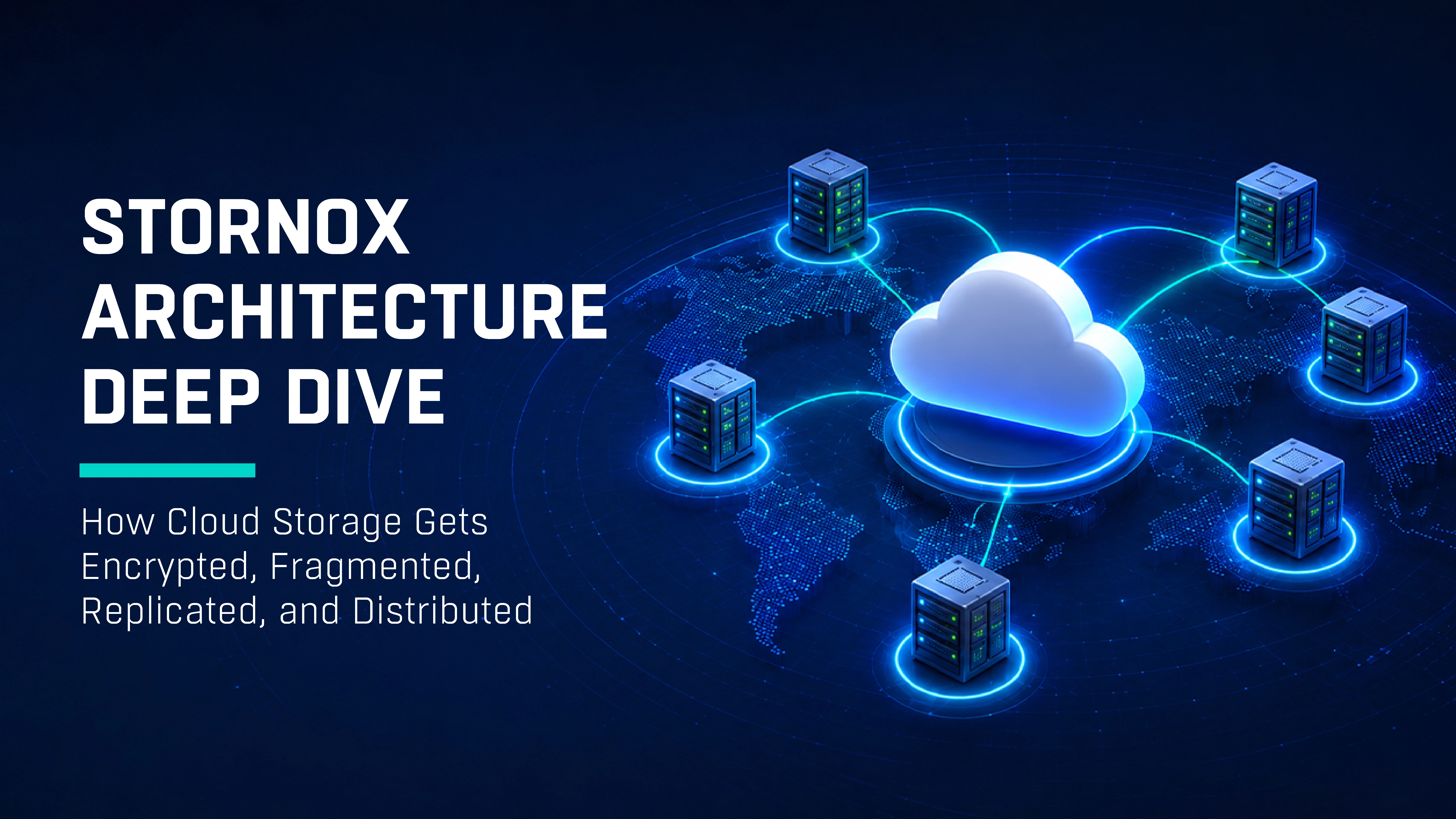
Modern enterprises don't lose data because of bad luck. They lose it because their cloud storage architecture creates a single point of failure. Stornox was built on the premise that this is an engineering problem with an engineering solution. By chaining together four core mechanisms — encryption, fragmentation, replication, and geographic distribution — Stornox delivers a storage architecture that treats resilience as a structural property, not a feature toggle.
Why Architecture Determines Everything
Most cloud storage failures, including data breaches, outages, and corrupted restores, trace back to architectural decisions made years before the incident. The configuration is just where the damage becomes visible.
Stornox takes a position that many vendors avoid. The security and durability model has to be baked into the data pipeline itself, not applied as a wrapper around an otherwise conventional object store. This matters to IT managers and CTOs because it shifts accountability from policy to infrastructure. You can audit an architecture. You cannot audit intent.
The four layers described in this post are not independent modules you can mix and match. They are a deliberate sequence. Changing the order, such as encrypting after fragmenting, for instance, rather than before, produces meaningfully different security properties. Understanding that sequence is the point.
Encryption: The Layer No One Should Skip
Encryption happens first. Always.
Before a file is touched by any other part of the pipeline, Stornox applies AES-256 encryption at the client side. This means the plaintext version of your data never leaves your environment. Stornox infrastructure operators cannot access or read your data by design, even if they wanted to. The encryption key never travels with the data.
The practical consequence for enterprise teams is that regulatory compliance becomes considerably more defensible. When auditors ask whether data-at-rest is encrypted, the honest answer isn't "yes, eventually" or "yes, on the server." It's "yes, before it moved." That answer holds up.
One important consideration is that client-side encryption places key management responsibility with the customer. That's an advantage for organizations with mature key management infrastructure. For teams without that capability, it adds an operational surface to manage, and Stornox provides managed key options for that scenario.
Fragmentation: Why Whole Files Are a Liability
After encryption, files are broken into fixed-size fragments. Stornox's fragmentation engine typically produces shards in the range of 1–4 MB per fragment, though this is tunable based on workload characteristics.
The security argument for fragmentation is underappreciated. An attacker who intercepts a single fragment acquires nothing useful. The fragment is already encrypted and represents an arbitrarily small portion of the original file, with no structural context. Reassembly requires both the decryption key and the complete fragment manifest. Neither lives alongside the data.
But the operational argument is equally important. Fragmentation enables parallel transfer. When a 10 GB file is split into thousands of shards, those shards can transit to storage nodes simultaneously, dramatically reducing effective upload and retrieval latency compared to sequential transfer of a monolithic file. This is one place where Stornox's architecture delivers performance as a side effect of its security design.
Replication: The Math Behind Durability
Each fragment is replicated across multiple independent storage nodes. Stornox uses a configurable replication factor, typically 3x for standard tiers, higher for compliance-sensitive workloads. This means three independently stored copies of every shard exist at any time.
Durability is not a vague promise here. With a 3x replication factor distributed across nodes with independent failure domains, the probability of simultaneous loss sufficient to cause data unavailability is, by conservative estimates, well below the industry standard of Fifteen-nines (99.999999999%). That figure assumes no correlated failures, which is where replication design choices matter most.
Correlated failure is the scenario most architects underweight. If three replicas all live in the same physical facility, a power event or network partition threatens all three simultaneously. Stornox's replication logic enforces placement constraints that prevent this by assigning replicas across distinct fault zones as a mandatory requirement rather than a recommendation.
One important consideration is that replication increases raw storage consumption. At 3x replication, you are storing the post-fragmentation data volume three times. For organizations managing petabyte-scale datasets, this is a budget consideration, not a theoretical one. The cost-efficiency calculation only works in your favor when you factor in the elimination of backup infrastructure, recovery tooling, and the operational overhead of managing those systems separately.
Geographic Distribution and Cost Efficient Cloud Storage
Distribution is the final stage, and the one that transforms a resilient architecture into a globally operational one.
Fragments that are already encrypted and replicated are distributed across geographically separated nodes. Stornox maintains node infrastructure across multiple regions, allowing fragment placement to respect data residency requirements, latency targets, and availability zone preferences simultaneously. For a multinational organization, this means you can enforce EU data residency for regulated datasets while still benefiting from globally distributed retrieval performance for unregulated assets.
Cost efficient cloud storage at enterprise scale usually requires a trade-off between storage price, egress fees, and operational simplicity. Stornox's distribution model is designed to minimize egress costs by serving retrieval requests from the geographically nearest node holding the relevant fragment set. Estimates from comparable architectures suggest egress optimization alone can reduce total storage spend by 15–30% for organizations with globally distributed users, though actual savings depend heavily on access pattern distribution.
And geography is not just about cost. It is the last line of defense against regional disasters. A flood, a data center fire, a regulatory seizure — none of these scenarios can affect fragments simultaneously distributed across three or more geographic zones.
How the Four Layers Work Together
The pipeline is linear, but the dependencies are circular.
Encryption without fragmentation leaves large encrypted objects that reveal metadata about file sizes and access patterns. Fragmentation without replication creates a brittle system where any node loss causes data loss. Replication without distribution just creates expensive redundancy within a single failure domain. And distribution without encryption means your data is geographically spread but still readable by whoever operates the nodes.
Each layer closes a gap that the others leave open. This is the architectural insight that most "secure cloud storage" marketing glosses over: the mechanisms are only effective as a system. Stornox's pipeline enforces this by making all four stages mandatory and non-bypassable at the infrastructure level.
.webp)
What This Means for IT Leaders
For a CTO evaluating cloud storage infrastructure, the relevant question is not whether a vendor offers encryption. Every vendor offers encryption. The question is where encryption happens, who holds the keys, and whether the architecture would survive an insider threat, a regional outage, or a nation-state level interdiction order.
Stornox's architecture answers all three. The client-side encryption model neutralizes the insider threat vector at the infrastructure level. The geographic distribution model handles regional failure. And the fragment-based design means that even a legally compelled disclosure of a node's contents yields nothing intelligible without the manifest and the key, both of which remain outside Stornox's possession.
For IT managers, the operational story is equally clean. Provisioning, monitoring, and key rotation are exposed through a standard API surface. There is no parallel backup infrastructure to maintain. And because durability is structural, recovery testing becomes a matter of verification rather than anxiety.
If your organization is ready to move beyond treating cloud storage as a solved problem, Stornox's team is available to walk through architecture fit, data residency requirements, and total cost modeling for your specific environment. Reach out to the Stornox team to schedule a technical review.
Frequently Asked Questions
What is Stornox and what makes it different from standard cloud storage?
Stornox is an enterprise cloud storage platform built around a four-stage data pipeline: client-side encryption, file fragmentation, multi-node replication, and geographic distribution. Unlike conventional object stores that apply security as a configuration layer, Stornox embeds these mechanisms into the data pipeline itself, making them architectural properties rather than optional settings.
How does Stornox's client-side encryption work in practice?
Files are encrypted on the client before any data is transmitted to Stornox infrastructure. The encryption key is generated and managed by the customer, meaning Stornox nodes store only ciphertext. Even with full access to the storage nodes, neither Stornox operators nor third parties can reconstruct the original file without the customer's key.
What happens if one of the storage nodes goes offline?
Because each file fragment is replicated across multiple independent nodes with a minimum replication factor of 3x, a single node going offline does not cause data unavailability. Retrieval requests are automatically routed to the nearest available replica. Data loss would require the simultaneous failure of all replicas for a given fragment. The placement constraints are specifically designed to prevent this scenario.
Is Stornox architecture suitable for regulated industries like healthcare or finance?
Yes. The client-side encryption model satisfies the data sovereignty requirements common in healthcare (HIPAA) and financial services (PCI-DSS, SOC 2) because plaintext data never transits Stornox infrastructure. You can configure geographic distribution rules to enforce data residency requirements for jurisdictions like the EU, making your compliance posture auditable at the infrastructure level.
How does fragmentation affect retrieval performance?
Fragmentation enables parallel retrieval; multiple fragments are fetched simultaneously from distributed nodes rather than pulled sequentially from a single location. For large files, this typically results in faster effective retrieval times compared to monolithic object storage, particularly when fragment nodes are geographically close to the requesting client.
Does storing three replicas of every fragment make Stornox expensive?
The 3x storage multiplier is real and worth calculating honestly. For organizations currently running parallel backup infrastructure, however, the consolidated cost often comes out equal to or lower than the sum of primary storage plus backup tooling, licensing, and operations. The cost efficiency case is strongest for organizations eliminating redundant systems, not for those adding Stornox on top of an existing stack.
What happens to my data if I stop using Stornox?
Stornox provides export tooling that reassembles and decrypts your data on customer infrastructure before egress, returning files to their original format. Because the encryption keys are customer-held, Stornox is not involved in the decryption process. You retain cryptographic control of your data throughout the relationship and after it ends.