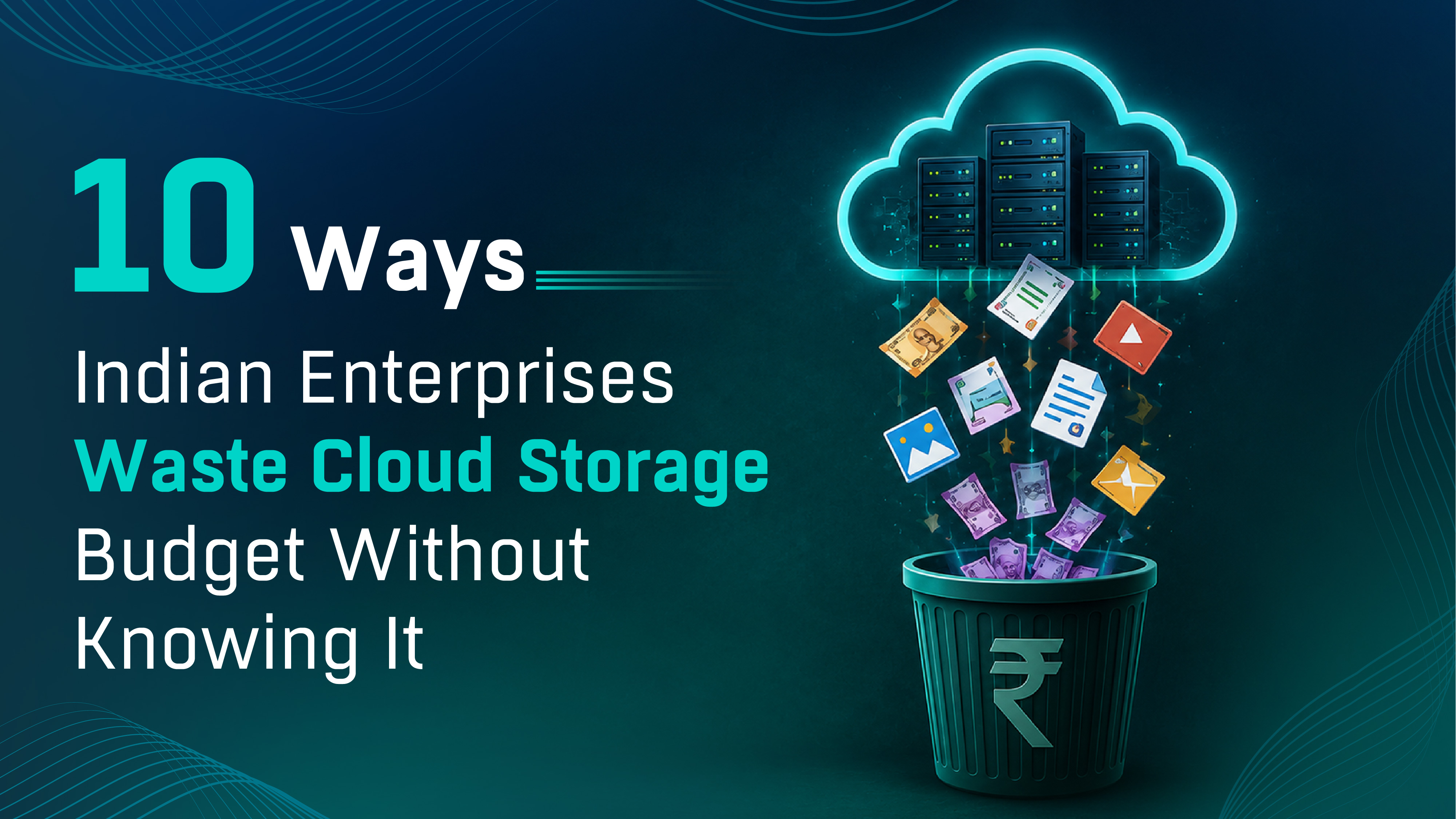
Cloud storage now runs quietly under almost every Indian enterprise's IT stack. But here's the uncomfortable truth: most companies are overpaying for it, sometimes by a lot.
The problem traces back to how fast the shift happened. Businesses moved to cloud-first setups at a pace their procurement teams and governance policies simply couldn't match. Nobody paused to build proper oversight — they were too busy migrating. What's left behind is a storage environment that's grown wide and messy, with almost nobody checking it closely. And in that gap, wasted spending just sits there, unnoticed.
Storing Data That Should Have Been Deleted Years Ago
This is the most widespread and least glamorous problem in enterprise cloud storage . Walk into any large Indian IT organisation, and you'll find petabytes of data that nobody queries, nobody audits, and nobody has the authority to delete. Legacy ERP exports. Email archives from 2014. Test datasets that were never cleaned up after a migration project were wrapped.
The problem isn't ignorance; it's governance. No one is assigned to ask: does this data still need to exist? So, it sits, accruing storage costs month after month, sometimes for years.
Ignoring Storage Tiers Entirely
Every major cloud platform offers hot, cool, and cold tier storage for a reason. Frequently accessed data costs more to store. Rarely accessed data should cost almost nothing. But many enterprise teams simply store everything in the default tier, which is almost always the most expensive one.
Cold data kept in hot storage is pure waste. There's no technical justification for it.
The solution is straightforward. Classify data by access frequency and move it accordingly. The deeper problem is that most teams haven't done the classification work, which means they can't automate what they haven't mapped.
Paying for Redundancy You Already Have
Cloud providers build geo-redundancy into many of their storage products by default. Enterprises then add their own replication layers on top, sometimes at the application level, sometimes through a third-party tool without realizing they're now storing three or four copies of the same data, paying for each one.
Redundancy is important. But redundancy you've forgotten about is expensive insurance you've already collected on.
Before adding any replication layer, it's worth auditing what the underlying cloud storage product already provides. In many cases, the built-in durability guarantees exceed what the enterprise policy actually requires.
Letting Shadow IT Create Parallel Storage Environments
This is where enterprise cloud spending in India gets genuinely chaotic. A development team spins up its own S3 bucket. A regional business unit signs up for a SaaS product that stores data independently. A data science team uses a personal AWS account and never migrates the project back to central infrastructure.
Each of these is small. Together, they can account for 15–25% of actual storage spends, a conservative estimate based on what infrastructure consultants typically find during cloud audits.
Cost-efficient cloud storage requires centralized visibility. Without it, you're budgeting against a partial picture.
Misconfigured Lifecycle Policies or None at All
Lifecycle policies are the automation layer that should be doing the classification work for you. They can move objects between tiers automatically, expire old versions, and delete data that's aged past its useful life. When they're configured correctly, they run silently and save money continuously.
Most enterprise environments have lifecycle policies that were set up during initial cloud onboarding and never touched again. Some have none at all.
An object storage bucket without a lifecycle policy is a bucket with no memory; it has no concept of time, age, or relevance. Everything just accumulates.
Egress Fees No One Budgeted For
Egress costs, which are the charges cloud providers apply when data leaves their network, are one of the most overlooked expenses in cloud budgets for many Indian enterprises. Teams calculate storage costs carefully, then overlook the fact that moving data to analytics platforms, partner systems, or on-premises environments costs money every single time.
This matters especially for organizations running hybrid architectures, which is the majority of large Indian enterprises. Data moving between cloud regions, or between cloud and on-prem, generates egress charges that stack up fast.
So, the architecture decision isn't just technical. It's financial.
Snapshots That Multiply Like Rabbits
Snapshots are useful. The problem is that most teams set them up as a safety net during a migration or a critical deployment cycle, then never remove them. A database that takes daily snapshots for two years, with no retention policy, can end up with 730 copies of data that's changed only marginally.
Snapshot sprawl is one of the fastest-growing sources of hidden cloud storage cost in enterprise environments. And because snapshots often live outside the main storage dashboard, they're easy to miss in budget reviews.
Over-Provisioning at Project Launch and Never Revisiting
Indian enterprises, like most large organizations, tend to provision for peak capacity at project launch. This is reasonable. What's not reasonable is treating that initial provisioning as permanent.
Projects scale down. Teams move on. Workloads change. But the storage allocation rarely shrinks to match. Engineers are busy. Revisiting old provisioning decisions feels like low-priority work compared to building new things.
The result is a consistent gap between provisioned capacity and actual usage, and the enterprise pays for it.
Treating All Cloud Storage as the Same Product
Object storage, block storage, file storage, and archival storage have meaningfully different cost profiles. Using block storage for data that only needs object-level access is one of the more expensive mismatches an enterprise can sustain over time.
This kind of technical mismatch often traces back to the initial architecture decision, made under time pressure, never revisited. The right storage type for a given workload isn't always obvious, but getting it wrong isn't neutral. It has a monthly price.
Cost-efficient cloud storage isn't just about cutting volume. It's about using the right product for each workload.
No One Owns the Storage Budget
This is the root cause underneath most of the other nine. Cloud storage cost is no one's job. DevOps teams manage availability. Finance tracks total cloud spend at a high level. IT managers focus on uptime. And the detailed question of what we are storing, why, and at what cost falls into the gap between all three.
Without ownership, there's no pressure to act. Waste accumulates not because people are negligent but because accountability is diffuse.
What Stornox Can Do About This
Stornox helps Indian enterprises get their cloud storage costs under control. Instead of manually deciding what goes where, its platform handles lifecycle management automatically, moving data to the right tier based on how it's actually being used, so nothing sits around racking up hot storage charges it doesn't need to. And because everything stays within India, compliance isn't an afterthought.
With transparent pricing and predictable data retrieval costs, Stornox removes the hidden charges that often inflate cloud bills.
Ready to Reduce Your Cloud Storage Costs?
Discover how Stornox helps enterprises simplify storage, improve performance, and avoid unpredictable data transfer costs.