Choosing a cloud storage provider is one of the most consequential infrastructure decisions your organization will make this decade. Get it right, and you gain a foundation that scales with your business, protects your data, and keeps your team productive. Get it wrong, and you're looking at migration nightmares, surprise costs, and security gaps that keep you up at night.
Before you sign a contract, it is important to ask the right questions. The answers can help you distinguish experienced cloud storage providers from vendors that simply make attractive promises.
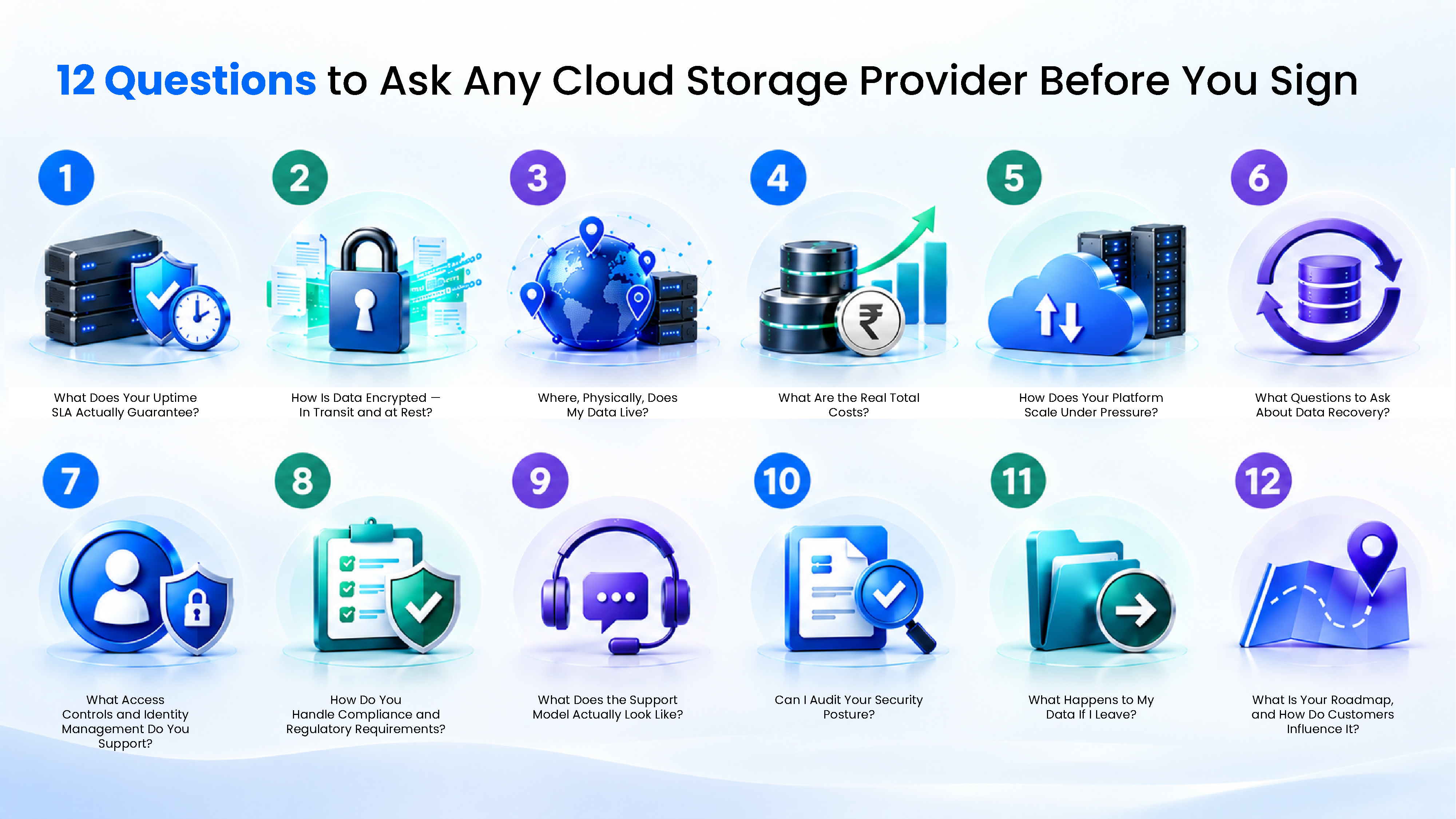
What Does Your Uptime SLA Actually Guarantee?
The SLA number a vendor highlights during sales calls is almost never the number that matters. Most providers advertise 99.9% availability, which sounds impressive until you calculate that it permits roughly 8.7 hours of downtime per year. For production systems, that can be a serious concern. Ask exactly what the SLA covers. It could apply to the storage API, the control plane, individual availability zones, or the entire platform.
Then ask what happens when the provider fails to meet the SLA. Service credits that amount to a fraction of your monthly bill are not compensation; they're a nuisance. A serious provider will clearly define measurement methodology, exclusion windows, and escalation paths. If those definitions are buried in exhibit C of a 60-page master services agreement, that tells you something.
How Is Data Encrypted — In Transit and at Rest?
Encryption is not optional. Every credible vendor will tell you they encrypt your data, so follow-up questions distinguish the careful from the careless.
Ask specifically whether the provider, you, or both manage the encryption keys. Customer-managed keys through a bring-your-own-key (BYOK) model give you much stronger control and much greater auditability. Find out which cipher suites are used, whether they support AES-256 for at-rest data, and how key rotation is handled operationally. And ask directly whether their staff can access your data. The answer to that last question should be no.
Where, Physically, Does My Data Live?
Data residency is as much a legal question as a technical one. Under frameworks like GDPR, certain data simply cannot leave specific jurisdictions. Even for organizations not yet subject to those frameworks, regional data sovereignty legislation is expanding fast, and choosing a provider with no clear answer on physical location is a liability you're absorbing today for a problem that may not surface until an audit two years from now.
Get written confirmation. A verbal assurance during a sales call is worth nothing in a contract.
What Are the Real Total Costs?
Egress fees have blindsided more IT budgets than any other line item in cloud infrastructure. Providers often advertise attractive per-GB storage costs while burying transfer fees that only trigger when you actually use your data. Ask for a total cost of ownership estimate based on your actual workload, your data volume, your access patterns, and your anticipated retrieval frequency.
It's also worth running the numbers on transfer costs ahead of time, based on how you actually expect to use the storage. If a good chunk of your stored data needs to come out regularly, egress charges can quickly turn into a major line item in your overall cloud spend, often a bigger one than people expect. Some providers serving enterprise workloads have cut egress fees dramatically, or dropped them altogether, and that's usually a sign of something deeper than a pricing tactic. It reflects a real commitment to cost predictability.
How Does Your Platform Scale Under Pressure?
The question isn't whether the platform scales in ideal conditions; it's whether it degrades gracefully when it doesn't. Ask specifically about behavior under high concurrency, during partial zone failures, and when your storage usage spikes unexpectedly. Can you scale capacity on demand without pre-provisioning or support tickets? What's the latency profile at your data volume, not at their median customer's data volume?
Performance benchmarks provided by the vendor are self-serving by definition. Request access to independent testing results or ask for reference customers at similar scale.
What Questions to Ask a Cloud Storage Provider About Data Recovery?
Recovery capabilities are the real measure of a storage provider's reliability commitment. Ask about recovery point objectives (RPO) and recovery time objectives (RTO) across different failure scenarios, including a corrupted object, a deleted bucket, and a full availability zone outage. These are different problems requiring different answers.
Find out whether versioning and point-in-time recovery are included or sold as add-ons. Ask how long deleted data is retained before permanent removal. And run a test restore before you sign anything. A provider that makes recovery testing difficult is telling you something important about what happens when you actually need it.
What Access Controls and Identity Management Do You Support?
Granular access control is non-negotiable for multi-team environments. Ask whether the platform supports role-based access control (RBAC), attribute-based access control (ABAC), and integration with your existing identity provider via SAML or OIDC. Ask how quickly access can be revoked when an employee leaves, and whether that revocation propagates instantly across all sessions and tokens.
The identity question is upstream of nearly every other security question. Weak access controls make strong encryption far less meaningful.
How Do You Handle Compliance and Regulatory Requirements?
Your provider's certifications matter, but they're a floor, not a ceiling. SOC 2 Type II, ISO 27001, and PCI-DSS are baseline expectations for any serious enterprise storage vendor. The more useful question is whether they can support your specific compliance obligations, including HIPAA for healthcare data, FedRAMP for US federal workloads, or sector-specific requirements your legal team has flagged.
Ask for audit reports, not just certificates. And ask explicitly who bears liability when a compliance failure originates in their infrastructure. That answer belongs in the contract.
Can I Audit Your Security Posture?
A provider unwilling to share penetration test results, vulnerability disclosure policies, or third-party audit reports should be removed from your evaluation list immediately. Transparency about security is not a competitive disadvantage for vendors doing things right; it's a differentiator.
Ask about their incident response process and disclosure timelines. You want to know, in writing, how quickly they are contractually obligated to notify you of a breach and how that notification happens.
What Happens to My Data If I Leave?
Exit conditions reveal the provider's confidence in their own product. Ask explicitly what happens when the contract ends. How long do you have to retrieve your data? What format is it provided in? Is there a retrieval fee? Is data destruction certified and documented?
Vendor lock-in is a real cost. Data portability, or the absence of it, is one of the most important questions to ask a cloud storage provider, and it's consistently the most overlooked.
What Is Your Roadmap, and How Do Customers Influence It?
This question sounds soft. It isn't. A storage platform that hasn't meaningfully updated its feature set in 18 months is likely losing the engineering investment required to stay competitive. Ask what has shipped in the last two quarters. Ask how enterprise customers surface feature requests and whether there's any formal mechanism for that feedback to influence priorities.
A vendor who can't answer this question with specifics is probably running on a skeleton crew.
Why Stornox Answers These Questions Differently
Stornox was built around a straightforward premise. Enterprise organizations deserve storage infrastructure that is transparent, technically robust, and designed for real operational demands rather than marketed around the lowest-friction sales cycle.
When you bring these questions to ask a cloud storage provider to a Stornox evaluation, the answers come with documentation rather than talking points. Data residency is contractually specified. Encryption key management defaults to customer control. Egress pricing is published without footnotes. And recovery capabilities are tested and documented before any deployment begins, not promised in slides.
The Stornox architecture is built for demanding workloads, including high-throughput environments, compliance-sensitive industries, and organizations that treat storage as critical infrastructure rather than a commodity line item. When the sales conversation ends and operations begin, the difference between a capable vendor and a capable partner becomes apparent quickly.
If you're currently evaluating storage infrastructure and want to work through these questions in the context of your specific environment, contact the Stornox team to schedule a technical assessment. This is a conversation between engineers, not a product demo.
Frequently Asked Questions
What are the most important questions to ask a cloud storage provider before signing a contract?
The questions that matter most are about data recovery, encryption key management, egress fees, and exit terms. These four areas are where the largest gaps between vendor promises and operational reality tend to appear. SLA percentages and marketing claims are secondary to understanding how a provider behaves when something goes wrong or when you decide to leave.
How do I evaluate a cloud storage provider's security credentials?
Start by requesting their SOC 2 Type II report and any relevant certifications such as ISO 27001 or PCI-DSS. Then go further: ask for penetration testing results, their vulnerability disclosure policy, and their breach notification timelines. A provider comfortable sharing this documentation is demonstrating security confidence; one that hedges or delays is not.
What is data egress, and why does it affect my cloud storage costs?
Egress refers to data transferred out of the storage platform — to your applications, to your users, or to another provider. Many cloud storage vendors charge per-gigabyte fees for this transfer, which can dwarf the cost of storage itself for read-heavy workloads. Always model your total monthly cost based on actual data access patterns before accepting a pricing proposal.
What should I look for in a cloud storage SLA?
Look beyond the uptime percentage. The meaningful details are what the SLA covers (storage API, control plane, specific regions), what is excluded, how downtime is measured, and what remediation is offered when the SLA is breached. A credit worth 5% of your monthly bill does not compensate for a multi-hour outage affecting production systems.
How do I avoid vendor lock-in when choosing a cloud storage provider?
Ask directly about data portability before signing. Find out what format your data is returned in at contract end, whether retrieval fees apply, and how long you have to complete the export. Prioritize providers that use open or standard storage protocols and that do not impose punitive exit conditions. Lock-in is often structural, not accidental.
What does customer-managed encryption key management mean in practice?
Customer-managed keys (often called BYOK — bring your own key) means you hold the encryption keys that protect your data rather than the provider holding them. In practice, this means the provider cannot access your data even if compelled to by a third party, and you can revoke access to your data entirely by destroying your keys. It adds operational complexity but substantially increases your security and compliance posture.
What happens to my data if my cloud storage provider goes out of business?
This is a scenario most organizations fail to plan for. The contractual answer should specify data retrieval timelines, formats, and fees in a provider insolvency scenario. Operationally, the answer is to maintain recent exports or replication to a secondary provider for critical data. Relying on a single provider with no exit plan is an availability risk that no SLA can fully address. SEO Recommendations Meta Title: 12 Questions to Ask a Cloud Storage Provider Before You Sign Meta Description: Know the right questions to ask a cloud storage provider before signing. Cover SLAs, encryption, costs, and recovery to protect your organization's data. URL Slug: questions-to-ask-cloud-storage-provider CTA Suggestion: Download our free vendor evaluation checklist to score any cloud storage provider before you sign. <script type="application/ld+json"> { "@context": "https://schema.org", "@type": "Article", "headline": "12 Questions to Ask a Cloud Storage Provider Before You Sign", "description": "Know the right questions to ask a cloud storage provider before signing. Cover SLAs, encryption, costs, and recovery to protect your organization's data.", "author": { "@type": "Organization", "name": "Stornox" }, "publisher": { "@type": "Organization", "name": "Stornox" }, "mainEntityOfPage": { "@type": "WebPage", "@id": "https://www.stornox.com/blog/questions-to-ask-cloud-storage-provider/" } } </script> <script type="application/ld+json"> { "@context": "https://schema.org", "@type": "FAQPage", "mainEntity": [ { "@type": "Question", "name": "What are the most important questions to ask a cloud storage provider before signing a contract?", "acceptedAnswer": { "@type": "Answer", "text": "The questions that matter most are about data recovery, encryption key management, egress fees, and exit terms. These four areas are where the largest gaps between vendor promises and operational reality tend to appear. SLA percentages and marketing claims are secondary to understanding how a provider behaves when something goes wrong or when you decide to leave." } }, { "@type": "Question", "name": "How do I evaluate a cloud storage provider's security credentials?", "acceptedAnswer": { "@type": "Answer", "text": "Start by requesting their SOC 2 Type II report and any relevant certifications such as ISO 27001 or PCI-DSS. Then go further: ask for penetration testing results, their vulnerability disclosure policy, and their breach notification timelines. A provider comfortable sharing this documentation is demonstrating security confidence; one that hedges or delays is not." } }, { "@type": "Question", "name": "What is data egress, and why does it affect my cloud storage costs?", "acceptedAnswer": { "@type": "Answer", "text": "Egress refers to data transferred out of the storage platform — to your applications, to your users, or to another provider. Many cloud storage vendors charge per-gigabyte fees for this transfer, which can dwarf the cost of storage itself for read-heavy workloads. Always model your total monthly cost based on actual data access patterns before accepting a pricing proposal." } }, { "@type": "Question", "name": "What should I look for in a cloud storage SLA?", "acceptedAnswer": { "@type": "Answer", "text": "Look beyond the uptime percentage. The meaningful details are what the SLA covers, such as the storage API, control plane, or specific regions, what is excluded, how downtime is measured, and what remediation is offered when the SLA is breached. A credit worth 5% of your monthly bill does not compensate for a multi-hour outage affecting production systems." } }, { "@type": "Question", "name": "How do I avoid vendor lock-in when choosing a cloud storage provider?", "acceptedAnswer": { "@type": "Answer", "text": "Ask directly about data portability before signing. Find out what format your data is returned in at contract end, whether retrieval fees apply, and how long you have to complete the export. Prioritize providers that use open or standard storage protocols and that do not impose punitive exit conditions. Lock-in is often structural, not accidental." } }, { "@type": "Question", "name": "What does customer-managed encryption key management mean in practice?", "acceptedAnswer": { "@type": "Answer", "text": "Customer-managed keys, often called BYOK or bring your own key, means you hold the encryption keys that protect your data rather than the provider holding them. In practice, this means the provider cannot access your data even if compelled to by a third party, and you can revoke access to your data entirely by destroying your keys. It adds operational complexity but substantially increases your security and compliance posture." } }, { "@type": "Question", "name": "What happens to my data if my cloud storage provider goes out of business?", "acceptedAnswer": { "@type": "Answer", "text": "The contractual answer should specify data retrieval timelines, formats, and fees in a provider insolvency scenario. Operationally, the answer is to maintain recent exports or replication to a secondary provider for critical data. Relying on a single provider with no exit plan is an availability risk that no SLA can fully address." } } ] } </script> <script type="application/ld+json"> { "@context": "https://schema.org", "@type": "BreadcrumbList", "itemListElement": [ { "@type": "ListItem", "position": 1, "name": "Home", "item": "https://www.stornox.com/" }, { "@type": "ListItem", "position": 2, "name": "Blogs", "item": "https://www.stornox.com/blogs/" }, { "@type": "ListItem", "position": 3, "name": "12 Questions to Ask a Cloud Storage Provider Before You Sign", "item": "https://www.stornox.com/blogs/questions-to-ask-cloud-storage-provider/" } ] } </script>