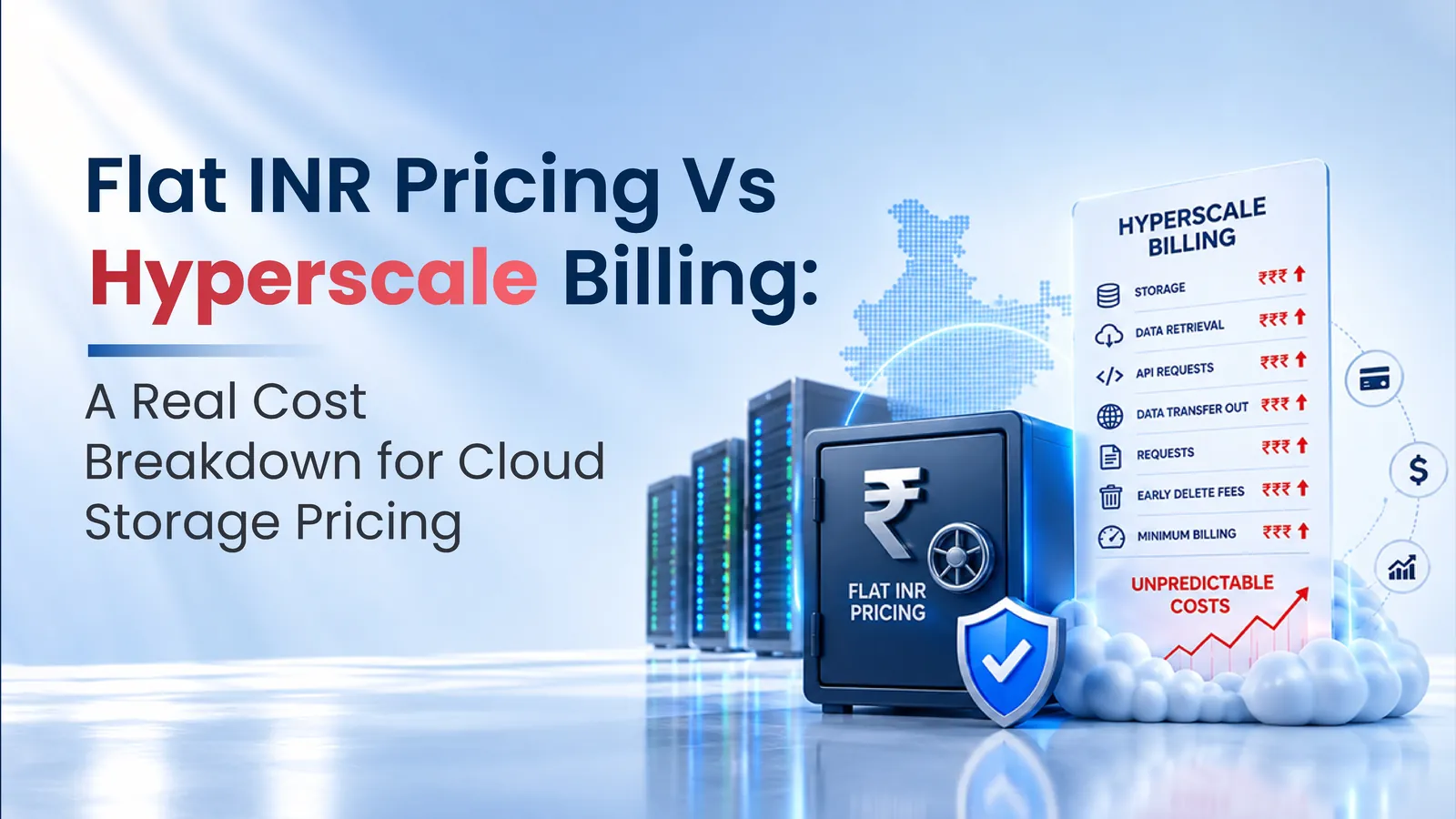
Indian enterprises are finally asking the right question. It is no longer simply about which cloud platform they should use, but about how much they are actually paying and what they are paying for.
Cloud storage pricing in India has become difficult to predict due to egress fees, per-request charges, and currency conversion surprises that make annual budgeting feel like a guessing game. This article cuts through the noise with a direct comparison of flat INR pricing models against hyperscale billing structures, so you can make a decision your finance team won't come back to question.
How Hyperscale Cloud Billing Actually Works
Most enterprise buyers underestimate how layered hyperscale billing really is. The storage cost per GB is usually the number that gets quoted in conversations and RFPs, but it's rarely the number that shows up on your invoice.
Hyperscale providers bill across at least four or five separate dimensions simultaneously, such as storage capacity, egress traffic, API request counts, replication tiers, and data retrieval class. Each of these is priced independently and fluctuates based on exchange rates that your procurement team has no control over. For a mid-sized enterprise storing 200–500 TB of mixed-access data, the gap between the "listed" price and the actual monthly bill regularly runs 25–35% wider than the original estimate.
The billing model is not accidental. It's architecturally designed to make cost attribution difficult.
The Real Cost of Cloud Storage Pricing on Hyperscale Platforms
This is where the conversation needs to get specific, because numbers tell this story far better than generalizations do.
Take a company storing 300 TB, with moderate traffic generating roughly 50 TB of outbound data transfer a month and around 10 million API calls. The storage cost alone might look reasonable on paper, but once you factor in data transfer charges and API request fees, the total cost of that environment climbs a lot faster than the initial estimate suggests.
Run the full calculation, and the effective cost per GB often ends up considerably higher than the headline pricing implies something enterprises managing large, frequently accessed datasets need to account for upfront, not discover later.
Then there's the currency question. INR-USD exchange rate swings hit Indian enterprises directly, changing the real cost of cloud services with zero change in actual storage or usage on their end.
Put it all together, the per-GB figure on a hyperscaler's pricing page is really just one line item in a much bigger picture, not the full cost of ownership it's often presented as.
What Flat INR Pricing Changes for Your Budget
Flat INR pricing means one thing above all else. Your cloud storage pricing is a fixed monthly number in rupees, regardless of your egress or how the dollar moves.
For IT managers who own the infrastructure budget, this is not a minor operational convenience. It's a structural shift in how you can plan, approve, and defend spend. When a CTO commits to a board that infrastructure costs will stay within a certain band for the financial year, flat pricing makes that commitment credible. Variable hyperscale billing makes accurate forecasting much harder.
Flat pricing also collapses the billing complexity. Instead of reconciling five separate line items from a hyperscale invoice, your team works from a single predictable number. This reduces the time spent on cost allocation, invoice reconciliation, and investigating unexpected charges. For a mid-sized team actively managing a hyperscale cloud environment, this can save several hours of administrative effort each month.
A Side-by-Side Cost Scenario: Flat vs. Hyperscale
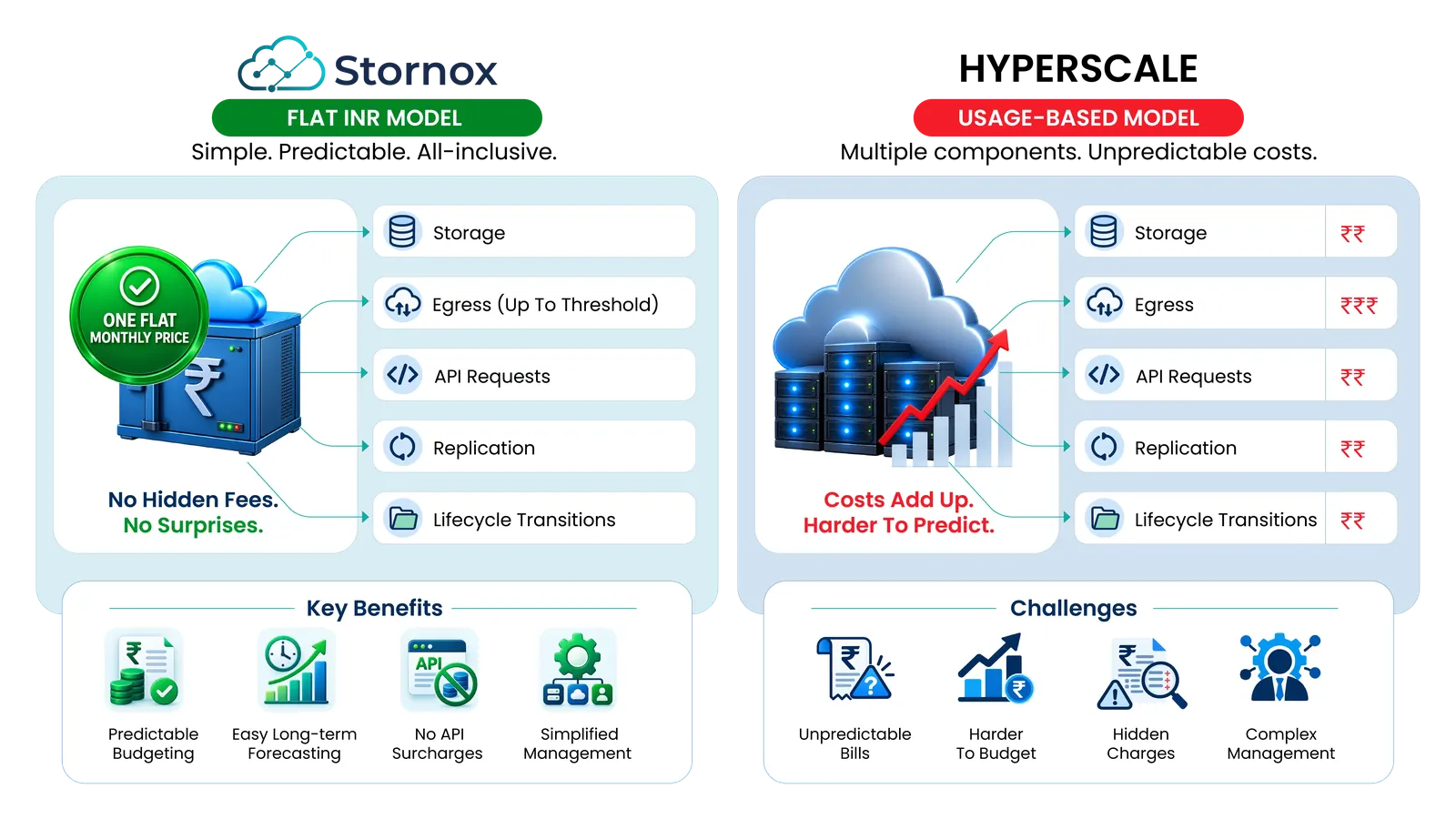
Let's make this concrete with a plausible scenario. Consider a 250 employee manufacturing company with 150 TB of storage, moderate egress of around 20 TB per month, and a mix of frequent and infrequent access patterns.
On a hyperscale platform, the monthly cost can come from several components, including storage, egress, API requests, replication, and lifecycle transitions. These charges are calculated separately, which can make the overall cost more difficult to predict and manage.
With Stornox's flat INR model, the same workload fits into a single predictable pricing tier. Egress can be included up to defined thresholds, with no separate API surcharges. This simplifies budgeting and makes it easier for the IT team to forecast long-term storage expenses.
The difference becomes more significant over several years, especially for organizations with stable, predictable storage requirements.
However, flat pricing works best when usage patterns remain reasonably stable. Businesses with highly unpredictable demand spikes, such as media companies experiencing sudden traffic increases, may need to evaluate their usage patterns carefully to determine which pricing model provides better overall value.
Where Hyperscale Still Makes Sense (And Where It Doesn't)
It is important to take a balanced view. Hyperscale platforms have genuine advantages that flat-pricing alternatives don't always match. This includes global edge presence, native integrations with hundreds of managed services, and near-infinite horizontal scale on demand. For truly global applications or organizations that deeply depend on the AWS or Azure service ecosystem, the cost premium can be justified.
But for most Indian enterprises, including companies running internal applications, backup and archival workloads, document management systems, or regional SaaS products, much of that global infrastructure may not be necessary. You're paying for a footprint you don't use.
The flat pricing vs hyperscale cloud pricing debate is ultimately about finding the right fit. Hyperscale platforms are the right choice for certain use cases, particularly those that require global scale and extensive cloud services. For many Indian IT environments with predictable workloads, a simpler and more predictable storage model can offer better value.
How Stornox Approaches Cloud Storage Pricing Differently
Stornox was built on a specific premise that Indian enterprises deserve infrastructure pricing in their own currency, on terms that reflect their actual usage patterns, without the billing opacity that hyperscale providers have normalized.
The Stornox model offers flat INR pricing across storage tiers, with egress bundled into plans rather than metered separately. Standard operations have no per-API charges, and pricing doesn't shift with USD exchange rates. For CTOs managing multi-year infrastructure budgets, this isn't just convenient; it's a fundamentally different risk profile.
Stornox's infrastructure is purpose-built for Indian data residency requirements, which matters increasingly as compliance obligations around data localization tighten. You're not routing your data through Singapore or Frankfurt because that's where the nearest hyperscale region happens to be. Your data stays in India, on infrastructure priced for India.
The platform supports S3-compatible APIs, so migrating from existing hyperscale environments doesn't require a re-architecture. Most teams complete the transition in days, not months.
If you're currently on a hyperscale plan and haven't done a line-item audit recently, now is a good time to pull the last three months of bills and calculate your effective per-GB cost, including egress and API charges. The number will likely surprise you. If you'd like Stornox to do that analysis alongside you and show you what the equivalent cost looks like on a flat INR model, reach out to the Stornox team for a no-obligation cost comparison. The numbers speak for themselves.
Frequently Asked Questions
What is flat INR pricing in cloud storage?
Flat INR pricing means your cloud storage costs are charged in Indian rupees at a fixed monthly rate, regardless of currency fluctuations or variable usage dimensions like egress and API calls. It gives enterprises a predictable, single number to budget against rather than a bill that changes based on external market conditions. Most flat-pricing models bundle egress within defined thresholds, eliminating the largest source of billing surprise on hyperscale platforms.
How does hyperscale cloud billing differ from flat pricing?
Hyperscale billing charges separately for storage capacity, data egress, API requests, replication, and sometimes retrieval class — all typically denominated in USD. Flat pricing collapses these into a single INR-denominated charge. The practical difference is that flat pricing makes your monthly cloud storage costs forecastable to within a few percent, while hyperscale billing can vary by 20–40% month-to-month based on traffic patterns and exchange rates.
Is flat pricing always cheaper than hyperscale cloud pricing?
For stable, predictable workloads — which describe the majority of enterprise storage use cases — flat INR pricing is almost always lower on a total-cost basis once egress and API charges are factored in. The exception is workloads with highly irregular, spiky traffic patterns where you would only occasionally hit egress thresholds included in a flat plan. In those edge cases, the comparison becomes more nuanced and worth modeling specifically.
What hidden charges should I watch for in hyperscale cloud storage pricing?
The four most common sources of billing surprise are egress fees, API request charges, inter-region replication fees, and data retrieval costs on archival tiers like Glacier or Cool storage. Together, these can add 50–80% on top of the base storage cost for active workloads. Always calculate your effective per-GB cost using actual traffic data, not just the storage line item.
How do I migrate from a hyperscale provider to a flat-pricing platform?
Most flat-pricing providers, including Stornox, support S3-compatible APIs, which means your existing applications and tooling do not need to be rewritten. The migration process typically involves copying data using tools like rclone or AWS DataSync equivalents, updating endpoint configurations, and running parallel validation before cutover. For most 100–300 TB environments, a phased migration can be completed in two to four weeks without service disruption.
What happens to my pricing if INR depreciates against the USD?
With flat INR pricing, rupee depreciation has no effect on your bill — your contract is denominated in rupees, so the exchange rate is irrelevant. On hyperscale platforms priced in USD, a 5–10% rupee depreciation translates directly to a 5–10% cost increase with no change in your actual usage. Over a three-year infrastructure contract, this currency exposure can represent a material unbudgeted cost for Indian enterprises.
Does data residency matter when choosing between flat and hyperscale cloud storage?
Data residency is a distinct but related consideration. Indian regulations increasingly require that certain categories of data — financial records, health data, government-related workloads — be stored within Indian territory. Hyperscale providers offer Indian regions, but at a premium over their US and European regions, which can widen the cost gap further. Purpose-built Indian cloud providers like Stornox offer Indian data residency as the default, not as an add-on tier.