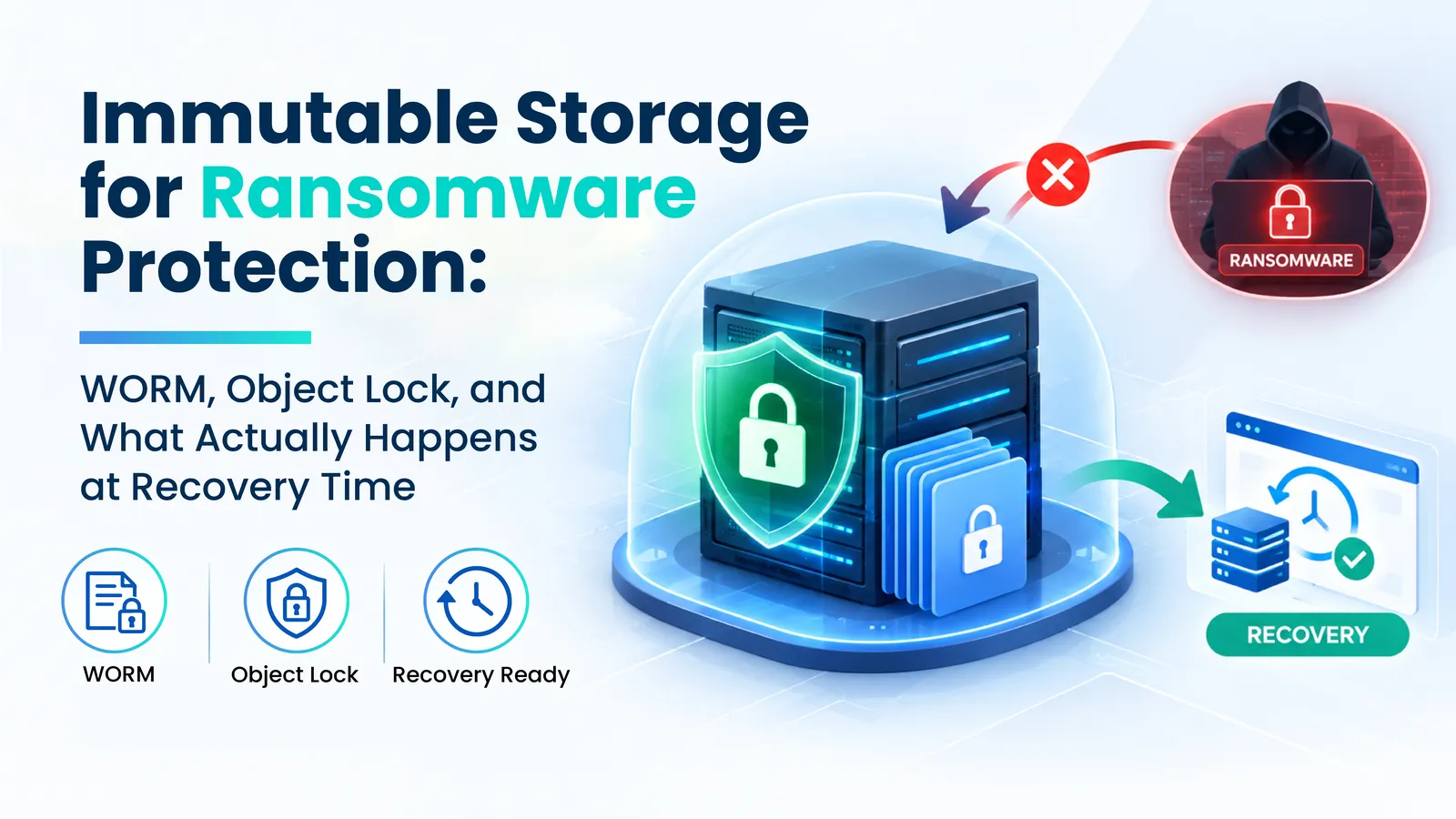
Ransomware doesn't simply break into your systems and destroy data; it waits. It moves laterally, maps your infrastructure, identifies backup repositories, and then encrypts or deletes data in the right order. That patient, methodical approach is exactly why immutable storage for ransomware protection has shifted from a nice-to-have to a genuine architectural requirement.
If an attacker with compromised credentials can delete, overwrite, or modify your backups, they aren't a reliable last line of defense. They're another asset an attacker can target.
For organizations building a modern backup strategy, S3-compatible object storage with Object Lock, versioning, encryption, and geo-distributed redundancy can provide multiple layers of protection against ransomware and infrastructure failure. Stornox DS3 is designed around this model, combining immutable storage capabilities with geo-distributed data protection.
What Immutable Storage Actually Means
Immutable storage means data written to a system cannot be modified, overwritten, or deleted for a defined retention period. The important part is where that protection is enforced.
A backup solution that prevents deletion through role-based access controls is not necessarily immutable. Access controls can be changed. Credentials can be compromised. Privileged accounts can be abused.
True immutability introduces a storage-level constraint that prevents protected object versions from being modified or deleted during their retention period. Think of it as the difference between a locked door and a sealed vault. A locked door depends on who holds the key. A sealed vault is designed to remain protected even when someone gains access to the surrounding environment.
For ransomware protection, that distinction matters because attackers increasingly target backup infrastructure after gaining access to production systems.
WORM vs. Object Lock: Knowing the Difference
WORM stands for Write Once, Read Many. The principle is simple: once data is written, it cannot be modified or deleted during the protection period. Object Lock is the S3-compatible implementation of this principle for object storage. It allows organizations to place retention controls on objects so that protected versions cannot be deleted or modified before their retention period expires.
Stornox DS3 supports S3 Object Lock, including Compliance mode, Governance mode, object retention periods, and Legal Holds. Object Lock requires versioning, and Stornox automatically enables versioning when Object Lock is enabled on a newly created bucket.
Compliance vs. Governance Mode
Governance mode allows authorized users with the appropriate permissions to bypass retention. Stornox documents that this can require the s3:BypassGovernanceRetention permission and the appropriate bypass request.
Compliance mode is intended for stronger retention enforcement and prevents protected object versions from being deleted or modified before the retention period expires. For ransomware recovery repositories, Compliance mode is generally the more appropriate choice when the objective is to prevent privileged users or compromised credentials from bypassing retention.
Stornox also supports Legal Holds, which allow individual objects to remain protected indefinitely until you explicitly remove the hold.
So the simplest way to think about it is:
WORM = protection principle.
Object Lock = S3-compatible mechanism for implementing that principle.
Why Immutable Backup Storage Changes the Recovery Equation
Recovery time is where immutability either delivers value or fails to deliver it. The question isn't only whether your backups survive an attack. It's whether you can identify a trustworthy recovery point and restore from it without spending days determining whether the backup repository itself was compromised.
An immutable backup copy changes that equation. Your recovery team can establish that the protected object version has not been modified or deleted during its retention period. But there is an important distinction.
immutability proves the stored object hasn't been altered; it doesn't automatically prove the original data was clean when it was backed up.
That is why a strong ransomware recovery strategy combines immutability with backup monitoring, anomaly detection, malware scanning, recovery testing, and appropriate retention policies. The goal isn't simply to preserve data. The goal is to preserve a usable recovery point.
How Immutable Storage for Ransomware Protection Works in Practice
A practical immutable backup architecture often follows the 3-2-1-1 strategy:
- 3 copies of important data
- 2 different storage media or environments
- 1 copy offsite
- 1 copy immutable or otherwise protected against modification
The immutable copy can sit on S3-compatible object storage with Object Lock, while geo-distribution adds another layer of resilience against site-level failures.
Where Stornox Adds Another Layer
With Stornox DS3, immutability isn't the only protection mechanism. Stornox's architecture encrypts data with AES-256, fragments it, applies redundancy, and distributes the resulting data across multiple locations. Stornox uses Reed-Solomon-based redundancy to maintain data durability even when nodes or locations become unavailable.
This creates multiple protection layers:
- Object Lock protects against unauthorized deletion or modification.
- Versioning preserves previous object versions.
- Encryption protects the confidentiality of stored data.
- Fragmentation and geo-distribution reduce dependence on a single physical location.
- Redundancy and self-healing help maintain availability when infrastructure fails.
That's fundamentally different from treating “backup” as simply another copy sitting beside production infrastructure.
What Immutable Storage Won't Do
Immutability is not a complete ransomware strategy. It's the recovery anchor, not the prevention layer. If an attacker spends three months inside your environment before triggering encryption, your immutable backups may all contain infected or compromised data.
That means retention needs to match your threat model. A seven-day retention window against a 90-day dwell-time attack may leave you with no trustworthy recovery point.
Immutable does not automatically mean clean. If compromised files were backed up before the ransomware attack was detected, Object Lock will preserve those files exactly as they were stored.
Organizations should combine immutable backup storage with:
- Backup anomaly detection
- Malware and ransomware scanning
- Multiple recovery points
- Appropriate retention periods
- Regular restore testing
- Recovery point validation
- Monitoring for unusual backup activity
Stornox's approach adds protection beyond Object Lock by combining immutability and versioning at the client/storage layer with encryption and geo-distribution at the infrastructure layer. Stornox describes this combination as “2X ransomware protection.” The objective is not to claim that one feature can stop ransomware, but to ensure that when prevention fails, your recovery architecture still works.
How Stornox Approaches Ransomware Protection
Stornox approaches ransomware protection through multiple complementary layers rather than relying on immutability alone.
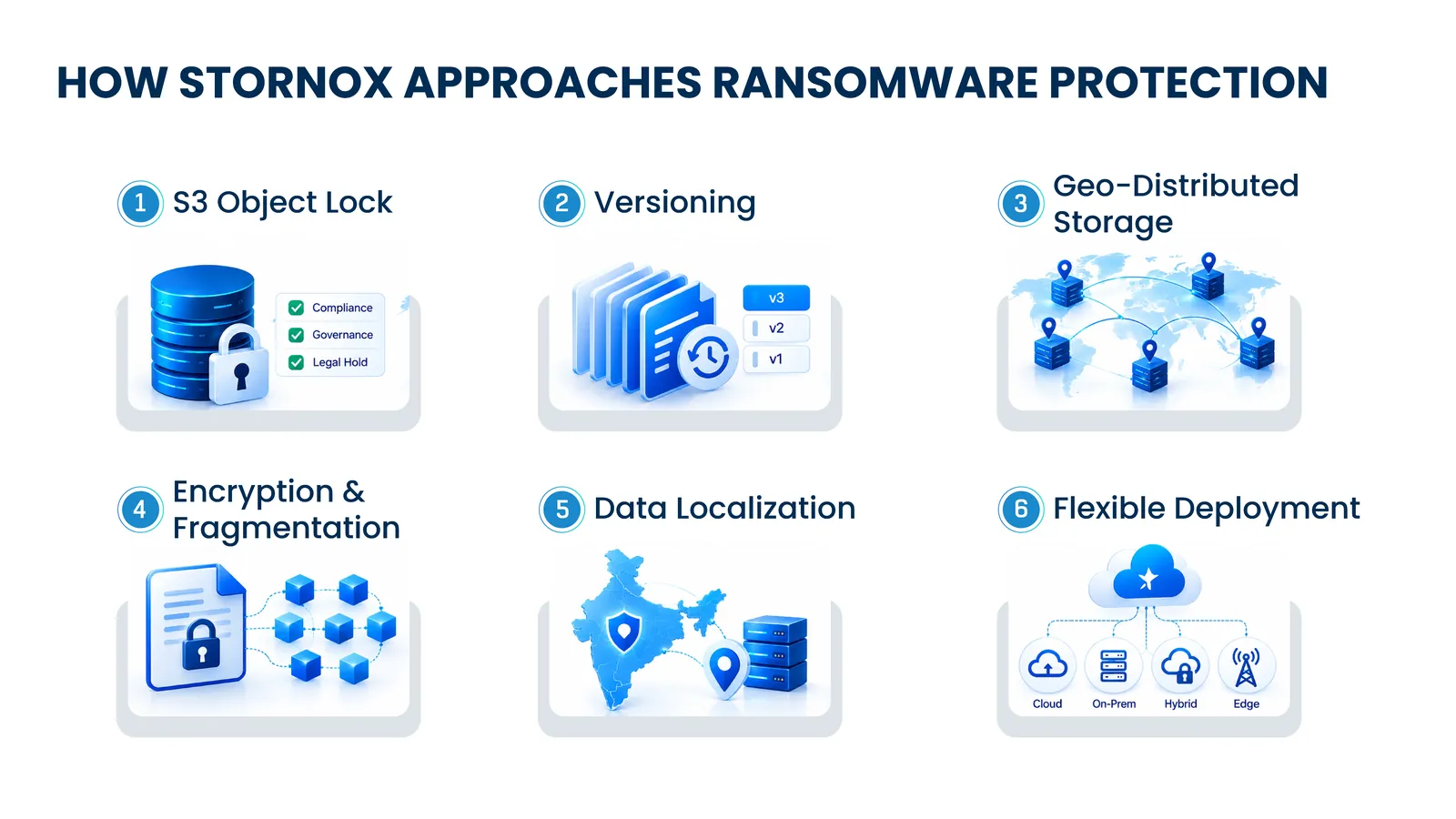
1. S3-Compatible Object Lock
Stornox DS3 supports S3 Object Lock with Compliance and Governance retention modes, allowing organizations to protect objects against deletion or modification for defined periods. It also supports Legal Holds for indefinite object-level retention. For backup environments, this provides the foundation for an immutable recovery tier. Stornox also supports integration with backup platforms such as Veeam, where S3 Object Lock can create immutable backup repositories.
2. Versioning
Versioning provides another layer of protection by preserving multiple versions of an object. If the same object is uploaded again, the previous version remains available instead of being overwritten. Stornox supports S3 bucket and object versioning, and versioning is required for Object Lock. This is useful during recovery because teams can identify and restore an earlier version instead of relying exclusively on the latest copy.
3. Geo-Distributed Storage
Stornox doesn't treat geographic distribution as an optional secondary copy. Its DS3 architecture encrypts, fragments, and replicates data across multiple locations according to configured redundancy policies. This helps protect against ransomware as well as site outages, infrastructure failures, and regional disasters.
4. Encryption and Fragmentation
Stornox encrypts data using AES-256 before distributing fragments across the storage infrastructure. The architecture is designed so that the distributed fragments do not represent a complete readable copy of the original object. Stornox also offers zero-knowledge capabilities through private key management, allowing organizations to maintain control over access to stored data.
5. Data Localization
For organizations with regulatory or sovereignty requirements, ransomware protection is only one part of the storage decision. Stornox allows organizations to define where data is stored through geo-fencing and data-localization capabilities. This can help organizations align storage architecture with regional regulatory requirements and internal data-residency policies.
6. Flexible Deployment
Stornox's DS3 technology can be deployed across cloud, on-premises, private cloud, hybrid, and edge environments. With DS3 Composer, organizations can use existing infrastructure and define their own redundancy, permissions, data-localization, and deployment policies. This gives enterprises flexibility when designing an immutable backup architecture rather than forcing every workload into a single centralized cloud environment.
How Stornox Approaches Immutability
Stornox is built around the premise that immutable storage for ransomware protection should be the default, not an enterprise add-on that requires a separate SKU and a professional services engagement to configure correctly. The Stornox platform enforces S3-compatible Object Lock at the storage layer across both cloud-native and on-premises deployments, with Compliance mode available without administrative override paths that could be exploited through credential compromise.
Retention policies at Stornox are set independently of the backup software layer, meaning a ransomware strain that compromises your backup agent cannot modify the retention configuration on the storage tier. The separation is architectural, not procedural. Stornox also provides versioning with immutable delete markers, so even the metadata record of what was stored is protected.
For teams that need to verify their immutable backups before a crisis, Stornox includes scheduled restore testing that writes results to an isolated environment and reports against the last known-good recovery point. You know your backups work before you need them.
If you're evaluating whether your current backup architecture would survive a credential-compromise ransomware scenario, the team at Stornox offers a no-obligation infrastructure review focused specifically on immutability gaps and recovery time risk. Contact us to learn more and schedule a technical assessment.
Frequently Asked Questions
What is immutable storage, and why does it matter for ransomware?
Immutable storage is a storage architecture in which written data cannot be modified, overwritten, or deleted for a defined retention period. Object Lock provides a storage-level mechanism that helps prevent protected object versions from being modified or deleted during that period.
What is the difference between WORM storage and Object Lock?
WORM, or Write Once Read Many, is the principle that data is written once and protected from modification or deletion. Object Lock is an S3-compatible implementation of that principle for object storage.
How long should immutable backups be retained to protect against ransomware?
There is no universal retention period. Retention should be based on recovery objectives, backup frequency, regulatory requirements, and the expected dwell time of potential attacks.
Can ransomware encrypt or delete immutable backups?
A protected object version cannot be deleted or modified while an applicable Object Lock retention period or Legal Hold is active. Governance mode can allow authorized users to bypass retention, while Compliance mode provides stronger retention enforcement.
What is the 3-2-1-1 backup rule, and where does immutability fit?
The 3-2-1-1 rule means maintaining three total copies of important data, two different storage environments or media types, one copy offsite, and one copy immutable or otherwise protected against modification.
Does immutable backup storage guarantee full recovery after a ransomware attack?
No. Immutable storage helps ensure protected objects have not been modified or deleted during the retention period, but it does not guarantee the original data was free from malware or corruption. Backup scanning, anomaly detection, multiple recovery points, and regular restore testing are also needed.
How does Stornox protect backups against ransomware?
Stornox combines S3-compatible Object Lock and versioning with encryption, fragmentation, and geo-distribution across multiple locations, adding resilience against infrastructure and site-level failures.
Can Stornox be used for enterprise backup?
Yes. Stornox DS3 is designed as S3-compatible object storage for backup use cases, including integrations with S3-compatible backup software such as Veeam.
What makes geo-distributed storage useful for ransomware recovery?
Immutability protects stored objects from unauthorized modification or deletion, while geo-distribution addresses physical or infrastructure-level failure by distributing encrypted and redundant data across multiple locations.
What should organizations check before choosing immutable storage?
Evaluate S3 compatibility, Object Lock modes, versioning, retention controls, geo-distribution, encryption and key ownership, backup integrations, recovery testing, data residency, and operational flexibility.