Choosing the wrong object storage provider doesn't just slow down your applications. It can quietly drain your budget, create compliance exposure, and introduce latency you'll spend months debugging.
For Indian enterprises evaluating S3-compatible storage in India, the market has expanded fast, but not all offerings are equal. Before you sign a contract or spin up a bucket, there are a few things worth examining carefully, and some of them don't appear on any vendor's feature comparison page.
Why S3 Compatibility Isn't a Binary Thing
Most vendors will tell you their platform is “S3-compatible.” Take that claim seriously, but don't take it at face value.
S3 compatibility exists on a spectrum, and the gap between partial and broader compatibility can surface at the worst possible moment, typically during migration, integration, or a production incident.
At minimum, evaluate whether the platform supports the S3 operations your workloads actually depend on, including:
- PutObject
- GetObject
- DeleteObject
- ListBuckets
- ListObjects
- CopyObject
- Multipart uploads
- Presigned URLs
- Versioning
- Object Lock
- Access controls
- Bucket policies
But don't stop at the basic API list. Your application may depend on features such as lifecycle management, object tagging, notifications, and advanced access-control behavior.
Stornox supports many core S3 capabilities, including multipart uploads, versioning, Object Lock, ACL APIs, CopyObject, bucket operations, and other standard object-storage functionality. Its documentation also clearly identifies certain limitations, including unsupported Object Lifecycle and Bucket Tagging functionality.
Test your actual workload
Don't rely entirely on documentation or a simple bucket-creation test. Connect your backup software, application, data pipeline, or migration tooling and run representative workloads.
Compatibility problems don't always produce obvious errors. Sometimes they appear only when you use a specific API, object size, access pattern, or workflow.
Data Residency and Compliance: The Non-Negotiables for Indian Enterprises
For Indian enterprises, data sovereignty isn't a theoretical concern. Organizations operating in regulated sectors or handling sensitive customer and business information need to understand exactly where their data is stored, how it is replicated, and who controls the underlying infrastructure.
The first question should therefore be: Where does my data actually live?
Don't assume that an India-facing endpoint automatically means that the underlying storage infrastructure is located in India. Ask vendors for specific information about:
- Physical data-center locations
- Storage-node locations
- Metadata processing and storage
- Backup locations
- Replication locations
- Encryption-key management
- Data-transfer paths
- Data deletion procedures
- Geographic restrictions available to customers
This becomes particularly important with distributed storage architectures. Stornox's DS3 technology is designed around geo-distributed storage. Data is encrypted, fragmented, and replicated across multiple locations.
Performance Factors That Actually Matter at Scale
Latency numbers in marketing decks are almost always best-case figures. What matters in production is how consistently the platform performs under concurrent load, mixed workloads, network variation, and partial failures.
For most enterprises, two scenarios expose storage performance problems quickly.
High-concurrency small-object reads
Applications that generate large numbers of small objects can place significant pressure on metadata handling, API processing, and connection management.
Sustained multipart uploads
Backup platforms, data lakes, media archives, and AI workloads often involve large files and sustained data transfers. Multipart upload support becomes particularly important here.
Stornox supports multipart uploads and allows multiple gateways to operate in parallel. Its gateway architecture can be deployed on-premises, in public-cloud environments, or at the edge, with optional caching for workloads that benefit from faster or repeated reads.
Instead of forcing every workload through a single central access point, organizations can deploy gateways closer to applications or users. But don't rely on theoretical architecture alone. Benchmark:
- Small-object read latency
- Large-object read throughput
- Small-object write performance
- Multipart upload throughput
- Concurrent request performance
- Gateway performance
- Cache effectiveness where applicable
- Performance during node or network failures
The right storage platform is not necessarily the one with the lowest latency in a benchmark. It is the one that delivers consistent performance for your actual workload.
Pricing Architecture: Where the Real Cost Lives
Storage pricing is rarely as simple as the advertised cost per GB. Depending on the provider, the final bill can include:
- Storage capacity
- API requests
- Data retrieval
- Egress
- Cross-region transfers
- Replication
- Deletion
- Data migration
- Additional storage tiers
This is why comparing only the storage price can produce misleading results. Suppose two providers offer similar storage rates. Provider A charges separately for API operations and egress. Provider B includes those costs in a flat storage rate. The cheaper storage price doesn't necessarily mean the cheaper platform.
Stornox currently promotes a flat-rate pricing model for its DS3 offering, with no additional charges for egress, deletion, bucket replication, or API calls. For organizations with significant data movement, this can simplify cost modeling.
Before choosing a provider, model:
Storage + API activity + reads + egress + replication + retrieval + migration
Do this over at least three years. Don't compare today's storage bill. Compare the total cost of ownership.
Evaluating Vendor Support in the Indian Market
A support SLA is only as good as the team behind it. For mission-critical workloads, you need support engineers who understand:
- Your storage architecture
- Your application stack
- Your backup platform
- Your security requirements
- Your compliance environment
- Your migration strategy
This becomes particularly important when adopting a distributed storage architecture. With traditional centralized storage, the operational model is relatively straightforward: connect to the storage service and consume capacity.
With geo-distributed storage, enterprises should also understand how nodes, gateways, replication, redundancy, and failure recovery are managed.
For Indian enterprises, the important question is not simply “Does the provider offer 24/7 support?” Ask: “Can the provider support the architecture I'm actually deploying?”
What to Look for in the Best S3-Compatible Storage in India
After working through the technical, compliance, performance, and commercial dimensions, the evaluation reduces to a practical checklist.
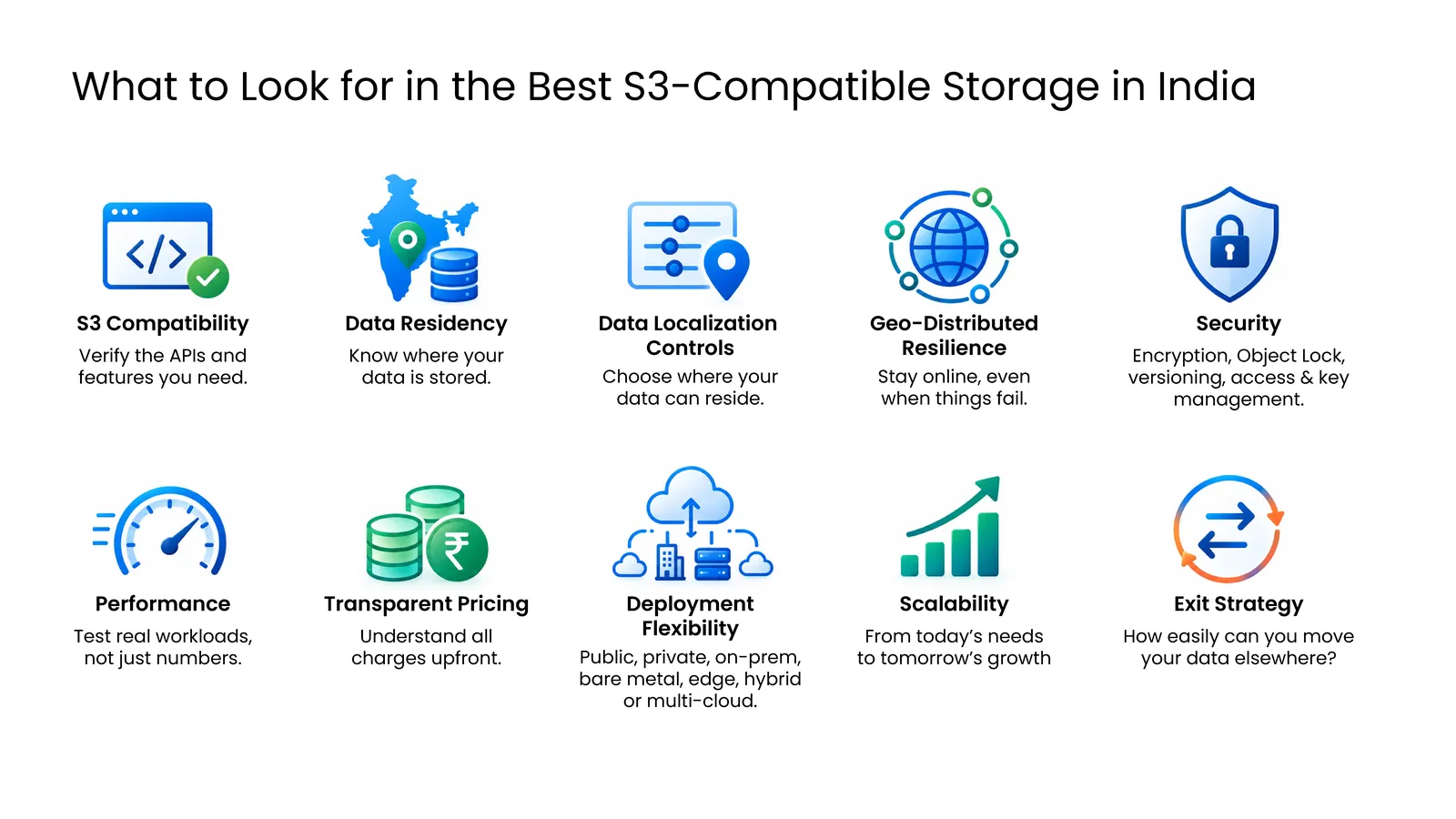
1. S3 compatibility
Verify the APIs and features your applications actually require.
2. Data residency
Confirm exactly where data, fragments, replicas, and metadata are stored.
3. Data localization controls
Check whether the platform allows you to define where data can reside.
4. Geo-distributed resilience
Understand how the architecture behaves when individual nodes, locations, or network paths fail.
5. Security
Evaluate encryption, Object Lock, versioning, access controls, and key-management options. Stornox's architecture encrypts data before distributing it across the storage infrastructure, while its S3 API supports features such as Object Lock and versioning.
6. Performance
Test actual workloads rather than relying only on published latency numbers.
7. Transparent pricing
Understand storage, API, egress, deletion, replication, and retrieval charges.
8. Deployment flexibility
Consider whether you need:
- Public cloud
- Private cloud
- On-premises infrastructure
- Bare metal
- Edge locations
- Hybrid or multi-cloud deployment
9. Scalability
Check whether the platform can scale from your current requirement to the capacity you expect to need five years from now. DS3 Cloud is designed to support capacities ranging from terabytes to petabytes.
10. Exit strategy
Finally, ask the uncomfortable question: “How easily can I move my data somewhere else?”
S3 compatibility helps reduce application-level lock-in, but you should still evaluate migration limitations before committing production data.
How Stornox Approaches S3-Compatible Storage in India
Stornox is built specifically for Indian enterprises that need reliable, compliant, and cost-predictable object storage without the overhead of managing hyperscaler complexity. The platform offers full S3 API compatibility, not a subset, meaning your existing tools, SDKs, and workflows connect without modification.
Infrastructure is hosted within India, with data residency documentation available to enterprise customers as part of the onboarding process. Stornox's pricing model is designed around total cost transparency, including storage, API calls, and egress, all itemized clearly, and there are no surprise retrieval fees on standard storage tiers.
For enterprises evaluating the best S3-compatible storage in India, Stornox offers local infrastructure, full API parity, compliance-readiness for DPDP and sector regulations, and support from engineers who understand the Indian enterprise context. The platform is designed to handle production workloads, not just archival or backup.
If you're evaluating object storage options and want to understand exactly how Stornox fits your architecture, reach out for a technical consultation. The team works directly with IT managers and CTOs to map requirements to deployment configurations—a practical conversation about your workload.
Frequently Asked Questions
What does “S3-compatible storage” actually mean?
S3-compatible storage refers to an object storage platform that implements the S3 API, allowing applications and tools built around S3 workflows to connect to another storage platform. For example, Stornox supports many core S3 operations, multipart uploads, versioning, Object Lock, and ACL APIs, while its documentation identifies certain unsupported features and API limitations. Always compare the provider's supported API list against your application's requirements.
Is S3-compatible storage in India suitable for regulated industries like banking or healthcare?
It can be, but suitability depends on the provider's architecture and the specific regulatory requirements applicable to the organization. Enterprises should evaluate data location, data-transfer paths, encryption, access control, audit capabilities, data retention, disaster recovery, and applicable regulatory requirements. Do not assume that an S3-compatible label automatically means regulatory compliance.
How do I verify that a vendor's storage infrastructure is actually located in India?
Ask the vendor for written documentation identifying the physical storage locations. Also ask where replicas, metadata services, and backups are stored; whether geographic boundaries can be enforced; and whether the organization can choose storage locations. This is especially important with distributed storage platforms.
What is the biggest hidden cost in object storage pricing?
For many workloads, data-transfer and egress charges can become a significant component of the total cost. Also examine API request charges, retrieval fees, replication charges, deletion fees, cross-region transfer, migration costs, and minimum storage commitments. Stornox's current pricing model states that egress, deletion, bucket replication, and API calls are included without additional fees.
Can I migrate from AWS S3 to a local S3-compatible provider without rewriting my application?
In many cases, yes. If the application uses standard S3 APIs supported by the destination platform, migration may require little or no application-code modification. Applications that depend on AWS-specific services or unsupported S3 APIs may require changes. Stornox also provides DS3 Bridge for S3-to-Stornox migration, although its current documentation lists limitations around features such as versioning, Object Lock, CopyObject, and certain metadata during migration.
What happens if a vendor's S3 compatibility is incomplete and my workload breaks?
Incomplete compatibility can result in failed API calls, unsupported operations, unexpected object behaviour, metadata differences, migration problems, application errors, or backup and restore failures. The practical impact depends on which features your application uses. Stornox's documentation identifies support for multipart uploads, versioning, Object Lock, and CopyObject, as well as unsupported functionality such as Object Lifecycle and Bucket Tagging. Test your actual workload rather than only testing whether you can connect to a bucket.
How should a CTO think about vendor lock-in with S3-compatible storage?
S3 compatibility can reduce application-level lock-in because applications using standard S3 APIs may be easier to move between storage providers. However, lock-in can still exist through proprietary features, data-transfer costs, migration limitations, contractual commitments, proprietary metadata, and operational dependencies. Deployment flexibility is another factor worth considering when evaluating long-term storage strategy.