Most Indian businesses overpay for cloud storage, not because they chose the wrong vendor, but because they never modeled what their actual consumption tier costs at scale. If you're a CTO or IT manager comparing object storage pricing in India, the number on the vendor's homepage is almost never the same as the amount that appears on your final invoice.
What Drives Cloud Storage Cost in India
Cloud storage price per TB in India is shaped by four structural variables: storage class, data residency, redundancy tier, and retrieval model. Most pricing pages show you only the first one.
Storage class determines base cost. Hot or standard storage for data accessed frequently sits at the top of the price curve. Cold or archival tiers can lower storage costs per TB, but retrieval latency and per-request fees can erase those savings under the wrong access pattern.
Data residency matters more than most procurement checklists acknowledge. Providers operating data centers within India may price differently from providers routing workloads through offshore locations. Local data residency may come at a higher cost, but it can help address RBI, DPDP Act, and sector-specific compliance requirements alongside appropriate contractual and technical controls.
Redundancy tier is where buyers get surprised. Standard 3-replica geo-redundant storage costs more than single-region, which costs more than erasure-coded storage. Erasure coding distributes data across multiple nodes using mathematical reconstruction, providing strong durability with lower raw capacity overhead. It's the right choice for backup and archival workloads. It's wrong for millisecond-latency applications.
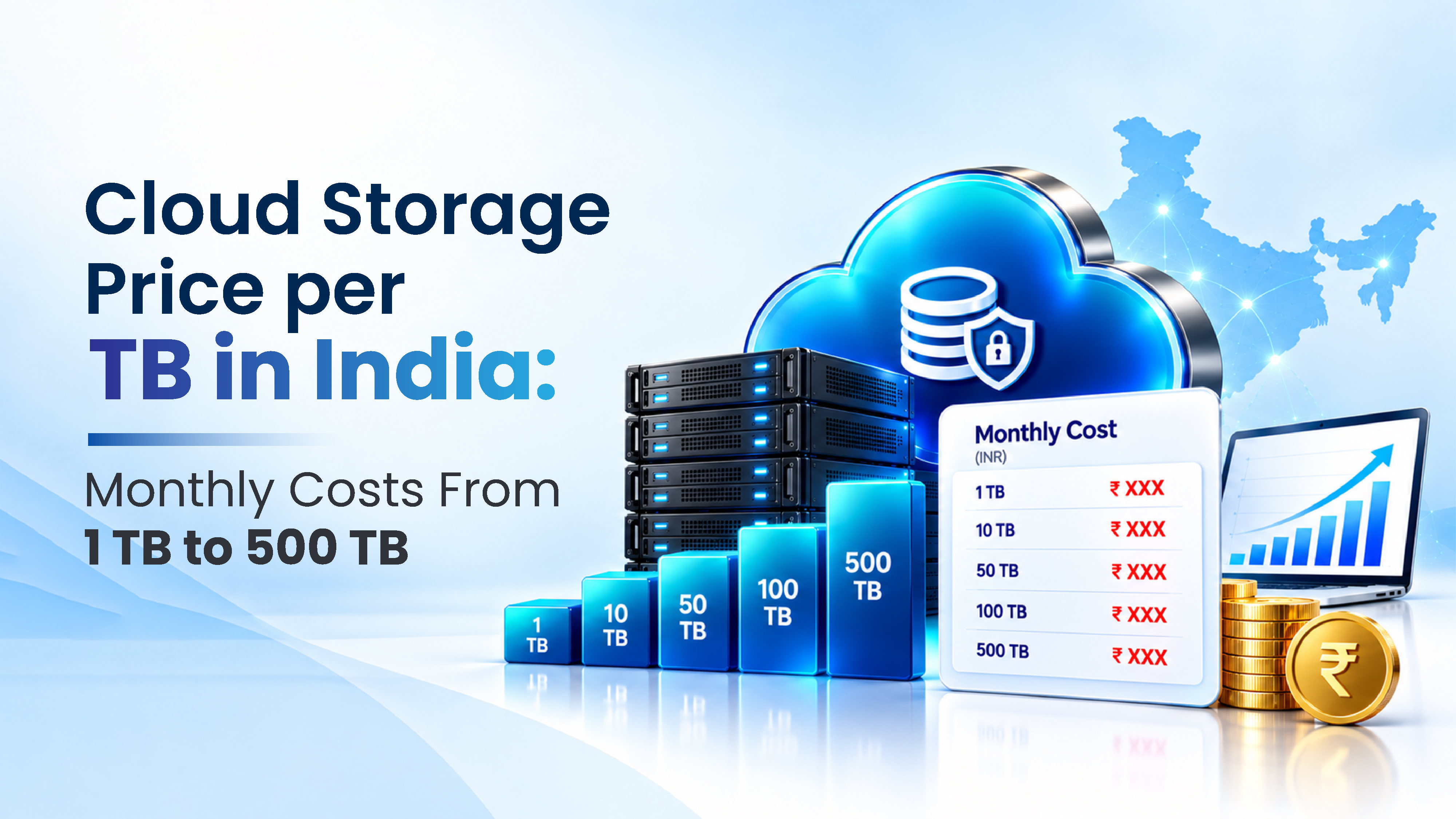
Price per TB at 1, 10, 100 and 500 TB
Storage costs depend on several things: how much data you hold, which storage class it sits in, how often it's accessed, and how the contract is structured. Even then, the same workload can be priced very differently from one provider to the next.
Volume discounts are real, but most of the benefit comes early. Moving from a small deployment to a larger one usually cuts your per-TB cost in a meaningful way. After that, every extra terabyte saves you a bit less than the one before, and the curve flattens out as the environment grows.
Vendor comparisons rarely mention this, but if you're holding a lot of cold data, an archival or cold tier should be your default, not an afterthought. Leaving rarely accessed backups in a warm tier is one of the most common budget leaks in infrastructure, and one of the easiest to avoid.
A small storage environment can look cheap on day one, but production workloads rarely stay that size. Applications, backups, logs, and business records keep accumulating. Pricing infrastructure around today's footprint alone is a planning mistake rather than real cost optimization.
Worked Example: A 50 TB Backup Workload
Consider a mid-sized enterprise running nightly full and incremental backups across three business-critical systems, totaling 50 TB of cold storage on a 90-day retention cycle.
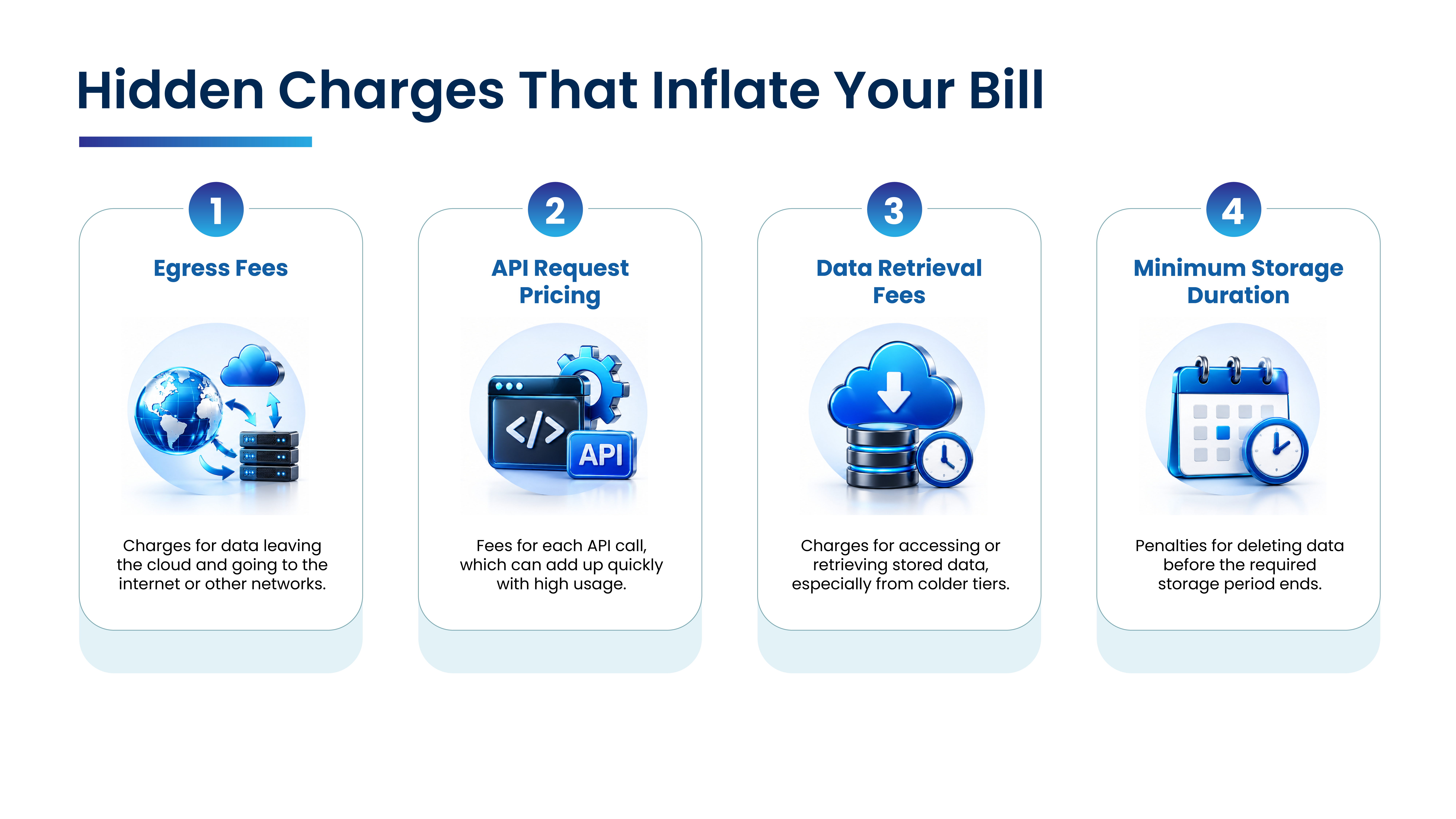
The base storage cost may appear clean and predictable when calculated using the storage rate. However, the actual cost also includes egress during monthly restore testing, API requests for backup-verification jobs, and overhead associated with minimum-retention clauses.
The total landed cost can therefore be significantly higher than the headline per-TB rate. That difference matters when presenting a quarterly infrastructure budget to the CFO.
Using a provider like Stornox, which offers transparent per-TB pricing with no egress fees on intra-region transfers and no minimum retention clauses on cold storage, this workload costs predictably against the quoted rate. For backup-heavy IT environments managing multiple workloads, that billing architecture reduces forecasting variance considerably.
How to Forecast Storage Growth
Storage-growth modeling is almost always wrong in the same direction: it is too conservative.
The most reliable approach is capacity-based projection using a 12-month rolling average of growth rate, not point-in-time snapshots. Use your organization's annual growth rate to model future requirements rather than relying only on the current footprint.
Apply different growth rates by data type. Structured database backups typically grow at a moderate annual rate. Unstructured data such as documents, media, and logs often grows much faster in organizations scaling digital operations. Treating all data with one growth assumption produces systematically inaccurate forecasts.
The key point is that most IT managers look for storage cost savings by optimizing the unit price. That is often the wrong lever. The larger savings come from tiering architecture, ensuring cold data lives in cold storage rather than defaulting everything to hot. Reclassifying large volumes of infrequently accessed data from standard storage to archival tiers can significantly reduce costs for that segment. That moves the needle faster than any vendor negotiation.
Use a cost calculator that accounts for storage class, retrieval frequency, and projected growth—not just current volume. Stornox's pricing calculator is intended to help IT teams simulate future cost trajectories before committing to a storage tier.
Ready to See What Your Storage Actually Costs?
Stornox offers India-hosted object storage built specifically for enterprise and mid-market IT teams, with transparent, INR-denominated pricing and no surprise egress fees on intra-platform traffic. Whether you're planning a pilot or a large scale migration, the Stornox pricing page and interactive cost calculator let you model real workload scenarios before you commit to anything.
Frequently Asked Questions
What is the average cloud storage price per TB in India for business use?
For hot or standard tier object storage in India, costs vary depending on storage volume and provider. Cold and archival storage generally costs less than hot storage. These are base storage rates, while actual invoiced costs can be higher when API fees, egress, and retrieval charges are included.
How does 1 TB cloud storage price compare to buying 10 TB at once?
Buying at the 10 TB tier typically reduces per-TB pricing compared to 1 TB pricing. Most Indian cloud providers use tiered volume pricing, so committing to a higher storage band upfront is cheaper per TB even if you don't immediately fill the capacity.
What is the difference between object storage and block storage pricing in India?
Object storage (S3-compatible) is priced per TB of stored data plus API requests and egress — it's designed for unstructured data, backups, and archives. Block storage is priced per GB of provisioned capacity regardless of how much you actually use. For large-scale storage, object storage is significantly more cost-efficient; block storage is appropriate for databases and OS volumes requiring low-latency access.
Are there cloud storage providers with data centers in India?
Yes. Several providers operate infrastructure within India, with nodes in Mumbai and Hyderabad being most common. Stornox offers Indian-hosted storage with local data residency, relevant for organizations subject to RBI guidelines, the DPDP Act, or sector-specific data localization requirements.
Why does my cloud storage bill keep coming in higher than the quoted per-TB rate?
The most common culprits are egress charges (data leaving the storage region), API request fees on high-frequency workloads, minimum retention billing on cold tier data deleted early, and inadvertent cross-region replication. Pull the line-item breakdown from your provider's billing console — most organizations find that non-storage charges account for 20–30% of total object storage spend.
How do I choose between cold and hot storage tiers for backup workloads?
If a dataset is accessed fewer than once per month, cold storage is the right tier economically. If it's accessed for regular restore tests, compliance audits, or analytics queries more than twice per month, hot storage avoids the retrieval penalty. For DR workloads that need sub-hour RTO, hot or warm tier is appropriate despite the higher base cost.
Is business cloud storage price in INR negotiable for large volumes?
At higher storage volumes, many providers may offer reserved capacity or committed use discounts. Annual commitments may also provide better commercial terms than month-to-month arrangements. For large enterprise deployments, direct agreements with SLA-backed pricing can be worth pursuing before accepting standard listed rates.